

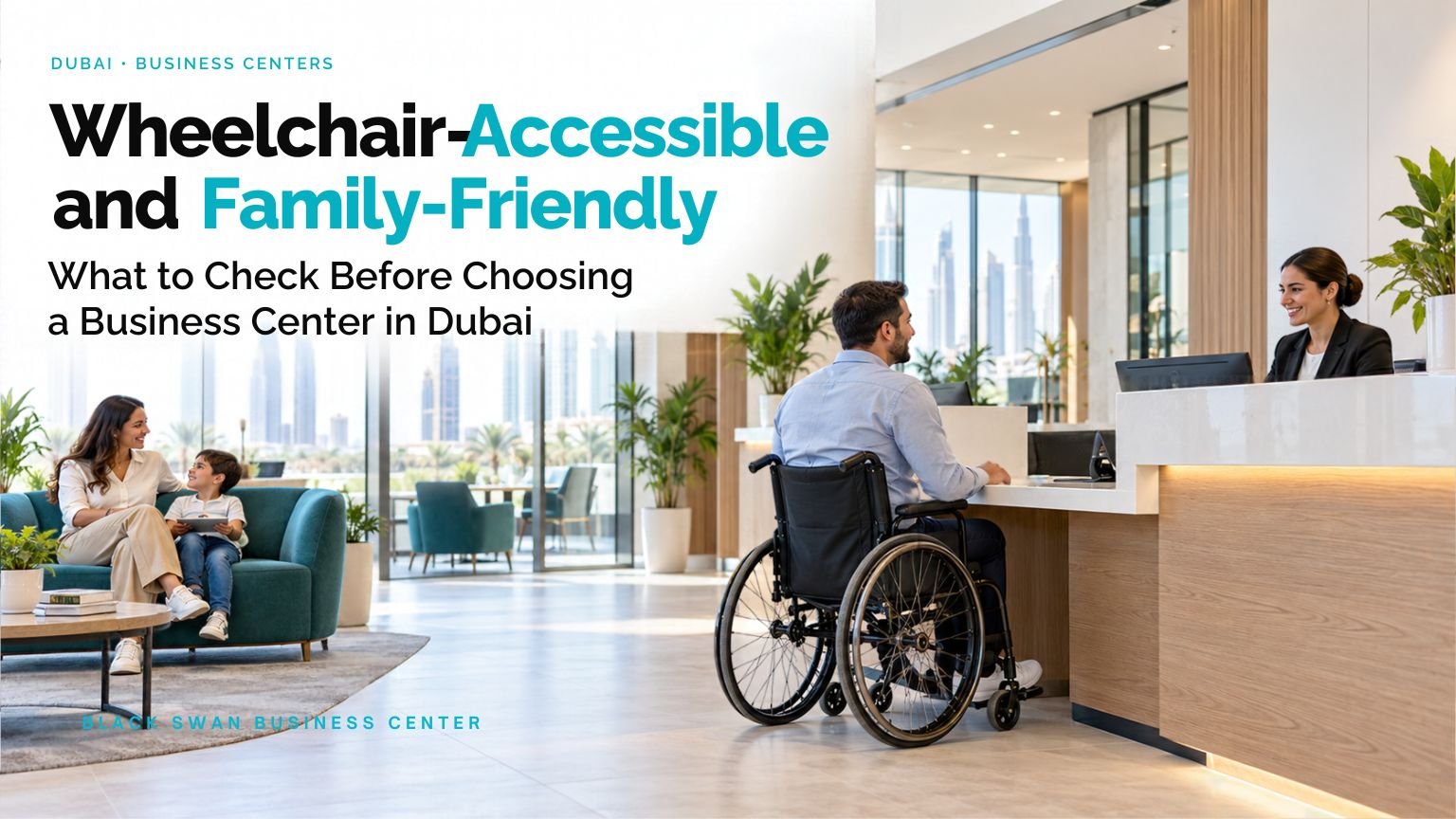
Most business centre comparisons in Dubai stick to the same three things: price, view and Wi-Fi speed. Useful, sure. But for a lot of people, the things that actually make or break a workspace never show up in those comparisons.
Can someone in a wheelchair get from the car park to their desk without having to ask for help? Is there somewhere quiet a new mum can step away to for twenty minutes? If a client with limited mobility comes in for a meeting, do they have to be taken round the back to the service lift?
You won’t find those answers in a brochure. So we’ve put together the checklist we’d want if we were choosing an accessible business centre in Dubai ourselves, along with the rules that sit behind it.
What the law says, briefly
Dubai doesn’t treat accessibility as a nice extra. It’s written into law.
Federal Law No. 29 of 2006 and Dubai Law No. 2 of 2014 protect the rights of People of Determination, which is the UAE’s official term for people with disabilities. The Dubai Universal Design Code was introduced in 2017 as the mandatory accessibility standard across the emirate. Then in 2021, Dubai Municipality built accessibility requirements into the Dubai Building Code itself, and new buildings now need a Wosool seal on their completion certificate to show they meet those standards.
For older buildings, there’s the Wosool service. Dubai Municipality assesses existing buildings against the Universal Design Code, and any building that scores at least 75% gets a certificate. Silver covers 75% to 90% compliance, and gold goes to buildings that go further, with smart assistive technology.
What this means in practice is that a modern tower in Business Bay should already meet a basic standard. Where things differ is how well the business centre inside that tower carries it through, all the way to the desk, the meeting room and the bathroom.
The wheelchair access checklist
Walk the route yourself before you sign anything. If you can’t make it in person, ask for a video tour.
| Where | What to look for | Why it matters |
|---|---|---|
| Parking | Accessible bays close to the lift lobby | The journey starts in the car park, not at the front door |
| Entrance | Step-free access, and doors that open automatically or easily | A heavy door is a barrier you face every single day |
| Lifts | Room to turn a wheelchair, buttons within reach, audio announcements | If the centre is on a high floor, everything depends on the lifts |
| Reception | Part of the counter at seated height | First impressions go both ways |
| Corridors and desks | Enough space between desks, and height-adjustable options | Shared spaces fill up fast |
| Toilets | An accessible cubicle on the same floor, with an emergency call point | Not three floors down |
| Meeting rooms | Step-free entry, chairs that move, space at the table | Your clients and visitors need this too |
| Emergency plan | An evacuation procedure that includes people with limited mobility | Ask how the staff are trained |
It’s also worth asking straight out whether the building has been assessed under Wosool. Whatever the answer, how clearly they give it tells you a lot about how seriously the operator takes this.
It’s about more than wheelchairs
Accessibility goes well beyond ramps.
Think about hearing: clear signs, visual alerts, and meeting rooms that don’t echo like a car park. Think about sight: signs with good contrast, tactile markers near the lifts, and staff who are happy to walk a first-time visitor to where they need to go. Think about neurodiversity, too. Quieter areas away from the busiest shared spaces make a real difference, and so does a booking system that works the same way every time. And don’t forget the digital side. The booking app and access system should work with a screen reader and a phone.
None of this needs a big budget. It just needs someone who’s actually thought about it.
Don’t just check the building, check the journey
An accessible office doesn’t help much if getting there is a struggle.
Business Bay is on the Dubai Metro Red Line, and the RTA has been upgrading stations and service centres to meet accessibility standards. Before you commit, have a look at the drop-off point outside the tower, how far it is from the nearest station or taxi rank to the entrance, and whether there’s any shade on that walk. That last one sounds minor until it’s August and you’re doing it every day.
What does “family-friendly” actually mean?
People use the phrase pretty loosely, so get specific when you ask.
Is there a private room for nursing or expressing milk? We don’t mean a meeting room you have to book a week in advance.
What are the access hours? Being able to come in at any time lets parents work around school runs and early mornings.
Can visitors bring children? Plenty of business centres have rules about kids in shared areas. Better to know before you need to.
Is there a lounge or café where a partner or child can wait for a little while during a meeting?
Are the contracts flexible? A lot of parents coming back from leave want to start small on a flexi desk and build up from there.
And is there parking near the lifts? Anyone who’s carried a car seat or pushed a buggy will appreciate that.
A family-friendly coworking space usually isn’t about play areas. It’s about flexibility, and accepting that work and family life overlap.
What we offer at Citadel Tower
Black Swan Business Center is on the 20th and 25th floors of Citadel Tower, on Marasi Drive. Our facilities include wheelchair access, parking, a guest lounge, a cafeteria, meeting rooms and a mini hall, and flexi desk members get 24/7 access. Those are the basics we commit to.
But honestly, we’d rather you test them than take our word for it. Book a tour, bring along whoever’s actually going to use the space, and walk the route from the car park to the desk together. If something doesn’t work for you, tell us. We want to know.
Questions to ask on any tour
“Can you show me the accessible toilet on this floor?”
“How would someone in a wheelchair be evacuated in an emergency?”
“Where could I go to feed my baby or take a private call?”
“Can my access hours change if my family’s schedule changes?”
“Has the building been assessed under Dubai Municipality’s Wosool programme?”
Listen to how they answer, not just what they say.
When the space is sorted but the paperwork isn’t
Picking a workspace often happens at the same time as setting up the company: the licence, your own visa, and sometimes visas for the people who depend on you.
That side is handled by our colleagues at Black Swan Business Setup Services, on the 37th floor of the same tower in Offices 3701 to 3702. They take care of company formation, residence visas and PRO work. If you’re already on a tour with us, they’re just a quick lift ride up, and we’re happy to introduce you.
The takeaway
An accessible business centre in Dubai should make the whole journey easy, from the parking bay to the meeting room, for every tenant and every visitor. Use the law as your starting point, take this checklist on every tour, and choose the place where the answers come quickly and honestly.
Sources: Dubai Municipality: Dubai Universal Design Code and Wosool · Gulf News on Dubai’s accessibility certification · Zero Project on the 2017 Universal Design Code
Questions people ask us
Do business centres in Dubai have to be wheelchair accessible?
Dubai’s Universal Design Code sets mandatory accessibility standards for buildings, and that includes commercial towers.
What is Wosool?
It’s a Dubai Municipality service that assesses existing buildings against the Universal Design Code and certifies the ones that comply.
What should I check first on an accessibility tour?
The full route from the car park to the desk, the accessible toilet on your floor, and the emergency evacuation plan.
What makes a coworking space family-friendly?
A private room for nursing, flexible access hours, clear rules about visitors, and flexible contracts.
Can I bring my child to a business centre?
It depends on the operator and the shared areas. Ask before you sign so there are no surprises later.

Join The Discussion